Legend
The Gibbet Law
Beat the blade, and you are free.
See it clearly
- What's there
- A tall wooden gibbet frame on a stone plinth
- Legend from
- Halifax Gibbet Law
- Best time
- Daytime
- Tone
- Grim
Legend · Halifax
Open on the map: directions, what's there today and read-aloud →
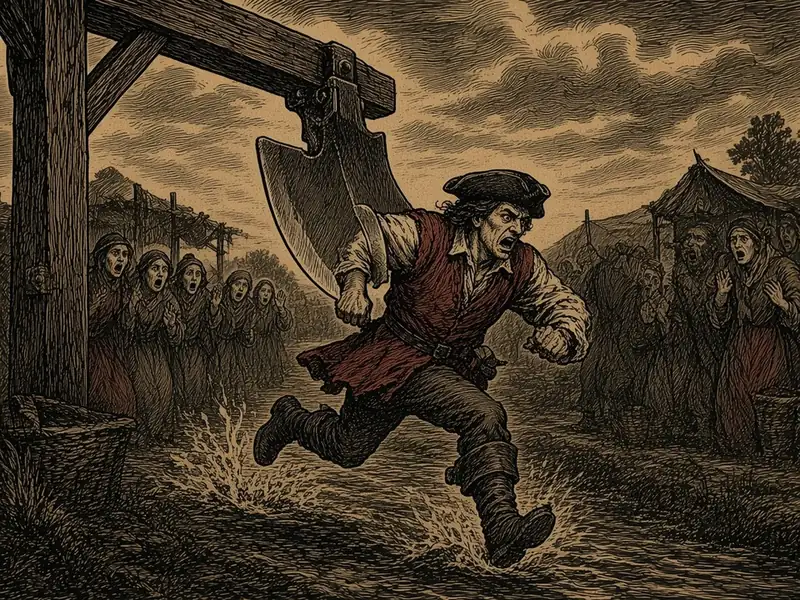
Beat the blade, and you are free.
See it clearly
Replica in a street setting; Visit Calderdale says it is fenced off during work. Check before you go.
Pull your head clear as the blade falls, outrun them to the brook, and you go free.
The Halifax Gibbet was an early guillotine. Under the Halifax Gibbet Law, a thief caught in the area could be tried and beheaded on market day. Almost 100 people were beheaded in Halifax between 1286 and 1650, when Oliver Cromwell forbade it. The Calderdale Companion says that if the accused could pull his head clear as the blade fell and escape across Hebble Brook, he went free. Wikipedia names two who escaped, Dinnis and Lacy; Lacy unwisely came back seven years later and was executed in 1623. A replica stands on the original base on Gibbet Street, and the original blade is at Bankfield Museum.